Thursday, May 2, 2019

Admiral Farragut Helps The Choctaws

Admiral David Glascow Farragut of the United States Navy aided the Choctaws of St.   Tammany Parish during the period of military occupation of New Orleans. Adrien Rouquette had met Farragut on a trip up north years before* the War.   His nephew, James Rouquette (Dominique's eldest son)  had sailed with Farragut on a mission which took him around the world by sea.   

Pere Rouquette,  after the burning of Buchuwa Village,  sent an urgent appeal to Admiral Farragut for permission to cross Lake Pontchartrain to bring much needed medicine, food and clothing to The Nook for his  suffering Indians. Farragut responded by sending a Federal gunboat up Bayou Lacombe to escort the Choctaw mis­sionary to New Orleans and back to Lacombe.


(Photo courtesy National Archives)


According to Wikipedia, Farragut was the first rear admiral, vice admiral, and admiral in the United States Navy. "He is remembered for his order at the Battle of Mobile Bay usually paraphrased as "Damn the torpedoes, full speed ahead" in U.S. Navy tradition."


"Born near Knoxville, Tennessee, Farragut was fostered by naval officer David Porter after the death of his mother. Despite his young age, Farragut served in the War of 1812 under the command of his adoptive father. He received his first command in 1824 and participated in anti-piracy operations in the Caribbean Sea. He served in the Mexican–American War under the command of Matthew C. Perry, participating in the blockade of Tuxpan. After the war, he oversaw the construction of the Mare Island Naval Shipyard, the first U.S. Navy base established on the Pacific Ocean."

Thursday, April 25, 2019

The Madisonville Cemetery

In 2012 Donald J. Sharp wrote an extensive history of the Madisonville Cemeteries. The cemetery is the second oldest continuous cemetery in the region, Sharp felt. Here is a portion of that account. 

Madisonville originally had two cemeteries in the early part of the nineteen century. One, which today is called the Madisonville Municipal Cemetery, is still in existence and the 
other, the Baham family  cemetery was removed in 1917 when the Jahncke Shipyard was built. The first, which started as the Parent family cemetery in the late 1700s was located in the northern part of Madisonville near Bayou Desire. It is still in operation to this day. The 

Baham family cemetery, which originated with the death of Juan Baptiste Baham in 1807, was located in the southern boundary of Madisonville about a half mile away downriver. It was located on the bank of the Tchefuncte River on Pierre Baham's, a son of old Juan Baptiste, Spanish land grant. It was these two families, the Bahams and the Parent families that were the first to settle on the Tchefuncte River after the British settlers left in 1779.

The two families were previously living in the Mobile area when hostilities broke out between the Spanish and British during the American Revolution in August of 1779. Charles Parent had his plantation on the west bank of Mobile Bay, high on a hill, burned down when the British attacked the Village. The Village was a Spanish Outpost located next to the Parent and Rochon Plantations. After the attack, Charles Parent took his family and moved across the bay to Spanish controlled Mobile. 

Later, he moved with his family to New Orleans. The Biaham's were living north of Mobile on their plantation on the Tensaw River, a few miles above Mobile. In 1782, the Baham's were in Mobile when Francoise Guillory, wife of Juan Baptiste dit Gentil died. Shortly after Francoise demise, Juan Baptiste and his five sons moved to New Orleans.

The Bahams and Parents did not stay in New Orleans very long. Charles Parent did try to buy a house in Bayou St. John in 1782 but at the auction, his bid was low. The Bahams had a shorter stay in New Orleans than Parents. It appears that it wasn't long after the Bahams arrived in New Orleans that the father, dit Gentil, petitioned the Spanish Governor, Estevan Miro, for a grant across the lake on the Tchefuncte River. 

The land had been vacant since September of 1779 with the start of hostilities between the Spanish and British. Word had arrived on the north shore that Galvez and his army were attacking the fort at Baton Rouge and the few remaining settlers on the river scattered in all directions. They took what they could and left. It was a hasty departure.

When old Juan Baptiste Baham requested a land grant for his family on the north shore, the War between the British and Spanish was still on. Even so, some New Orleans residents were already getting Spanish approval to settle on the contested land. It appears that Juan Baptiste Baham and his sons had the Governor's approval for a grant. 

Morgan Edwards had settled on a British grant at Bayou Castein as early as 1782 and Louis Reggio even earlier, in 1781 at Bayou Lacombe. 

It wasn't until the Treaty of Paris on September 4, 1783 and word was reached in New Orleans, some month and a half later, that the Spanish officially took control. The Spanish Governor approved a grant of 1000 arpents, (800 acres), to Juan Baptiste Baham two miles up on the West bank of the Tchefuncte River. This land had previously belonged to British settlers Thomas Berwick and James Oliphant. 


Some of the land had been cleared and was well developed by the British settlers. We know from records that the Bahams were living on their grant as early as April 24, 1783, some six months before the treaty of Peace was signed in Paris. The Baham grant was some of the best high land on the west bank of the lower Tchefuncte River.

After word was received in New Orleans that the War was over and peace had been declared between the Spanish and British, the Spanish Governor realized that there was a 
need for some authority of control on the north shore of the lake. He then appointed Charles Parent as Commandant of the Tchefuncte River area. The date of the appointment is not known but it was likely in late December, 1783 or early 1784. 

The Commandant's duties would be in the role of Sheriff, Justice of the Peace, and Judge in small matters, all rolled into one. When the newly appointed Commandant moved across the lake and started looking for suitable land to build his house and conduct the official duties of his office, he found that the best high ground on both sides of the lower river were already taken. The Bahams had the choice spot on the west side and the Lorrein's family had what high ground was on the east bank. 

Charles Parent did the next best thing to secure a spot on the lower Tchefuncte River. He purchased the Sarpy grant that was adjacent to the northeast boundary line of the Baham grant and on the river. Sarpy had purchased the land from Louis Allard, son-in-law of Jacques Lorreins II. Louis Allard had obtained the land as a Spanish grant in early 1784. It wasn't the best spot, but at least it was on the river and as close to the mouth that could be obtained.

At first, Commandant Parent's location on the river did not create a problem as traffic across Lake Pontchartrain from Bayou St. John to the Tchefuncte River was minimal. It was after 1787 when General James Wilkinson came down from Kentucky and reached an agreement with the Spanish authorities to allow flatboat traffic from Kentucky to deposit its farm produce at New Orleans. After that, the Tchefuncte River landing became increasingly important. 

As more and more flat boatmen arrived in New Orleans from upriver and deposited their cargos at New Orleans, the traffic from Bayou St. John to the Tchefuncte River increased dramatically! It was part of Parent's job to check the passports of travelers passing through and not to allow anyone to settle without official permission. Also, another aspect of his job was to welcome various Indian Chiefs and their delegations and to assist them in getting across the lake. 

It became increasingly difficult to carry out these duties from his location on the river. Just to the south of his southern boundary line was a strategic bend in the river, but it was on Baham's land. He asked the Spanish Intendant Juan Morales in New Orleans to adjust his southern boundary lines southward, along the river and adjacent to the Baham grant, to include a portion of this strategic bend. This was granted and Morales ordered Surveyor General Carlos Trudeau to make the adjustment. 

Needless to say, Trudeau got the two parties together and it was done, but it was not agreeable to old Juan Baptiste Baham and his sons. It would create a controversy between the two families that would last a long time.

When was each cemetery started? It is not known for sure when the first death occurred in the Parent family but when it did happen, a burial site was needed. It also could even have been a traveler from New Orleans that died on the north shore and needed to be buried quickly in Louisiana's climate. We do know from the records that Commandant Charles Parent and wife Jeanne Rochon had a young son named Joseph that died in 1790. Where to bury him? 

Much of their land was partially surrounded by low marshy ground. No, that would not be a suitable place. Should they pick out a spot far out in the woods? No, that seems to be rejected also. A few hundred steps from their home on the bend in the river was this beautiful ancient live oak on high ground. It was right below the drainage canal later  
called Bayou Desire, and also a short distance to the river. The large live oak is still standing today. In the mid-19th century it was given the name of "bathing oak" by the local inhabitants.

We do not know for sure if young Joseph Parent was the first to be buried and his burial was the start of the cemetery. We do know its location as Charles Parent Jr. stated in his will, written in 1858, that both his parents are buried in the cemetery and he describes the boundary lines of his property quite clearly. This description is very precise and it can be traced on a Tobin Map. When did his father, Charles Parent Sr. die? He died in 1804 and we can state with certainty that he is indeed buried in the cemetery. So we do know that the cemetery was in existence soon after the Louisiana Purchase occurred. 

How do we know that the original cemetery was the same one that was on the Parent property? There are several documents and maps that are undeniable evidence to this conclusion. The first and most convincing is the Will of Charles Parent Jr. of 1858. He states in his Will that it is indeed the Parent Family cemetery, that his father and mother are buried there, and that he plans to be buried there also. He then gives a description of the boundary lines of his property of 1854 which includes 406 acres and the cemetery. 

Charles also stated that he had Paris Childress, a surveyor from Covington survey his west bank land and it should be attached to his will. A copy of this survey, after an extensive search both in Covington and New Orleans, could not be located at this time. The key marker to Charles's boundary description in his will is the large live oak that he states that is call the "bathing oak" by local residents. It is still standing today in close proximity to the cemetery. 

It should be noted that Charles Jr., his sisters Josephine and Francoise Amiee were born on the Tchefuncte River. In September of 1804 Commandant Charles Parent Sr. died. 

While on his sick bed, his neighbor to the north, Robert Badon, came down and stayed with the Commandant. The Spanish Governor, with his armed armada, passing through the lakes on their way to Baton Rouge, stopped at the Tchefuncte River home and visited the sick Commandant. 

The Priest with the expedition gave the Commandant the last rites of the Catholic Church. The Commandant was buried the next day in this cemetery after he died. The next important resident to die on the lower Tchefuncte River was old Juan Baptiste Baham dit Gentil himself. He died three years later in 1807. He was not buried in the cemetery  
with Parent. His sons buried him on the bank of the Tchefuncte River about a half mile further south down river. It was on the land of son Pierre Baham.

Getting back to the Parent family, after Charles Parent Sr., the Commandant, died in 1804, his widow Jeanne Rochon continued to live on the Tchefuncte plantation. She died sometime before 1816 and was also buried in the cemetery. This was clearly stated in Charles Jr.'s Will of 1858. In 1816 there was a double wedding in the Parent family. 

Charles Jr. would marry Helwig Roman of St. James Parish and his sister Francoise Amiee would marry Helwig's brother, A.B. Roman, who would be elected twice as Governor of Louisiana.

Quick Burials Necessary

It was the custom in the late eighteen and early nineteenth century to bury a family member on one's property, usually several hundred feet from the house. In Louisiana, with the hot and humid climate most of the year, it was imperative to bury the deceased as soon as possible, usually the next day. The only places that had a municipal cemetery were the large towns or cities. New Orleans had a large cemetery but it was a long journey across the lake by boat. 

When Juan Baptiste Baham died in 1807 his sons decided to bury their father on their own property and certainly not close to the cemetery started by the Parents. They decided to bury their father about one half mile downstream, the same west bank, on Pierre Baham's Spanish grant. They selected a site of high ground on the river bank for the cemetery's site. 

As the years unfolded and Juan Baptiste Baham's sons died, it appears a pact was made to be buried together. The cemetery appears to be only for the five sons and their father. This is appears to be in the glass negatives taken of the cemetery when the Jahncke Shipyard was constructed in 1917. The bodies of the Bahams were disinterred and moved to a cemetery in Tangipahoa Parish.

When Commandant Charles Parent died in 1804, West Florida was still under the control of the Spanish and the adjusted boundaries between the Bahams and Parents was still in force. The West Florida Rebellion in the fall of 1810 started a chain of events that would return the boundary lines of qualified settlers to their original boundary lines. 

After West Florida became under the control of the United States Congress was concerned about the confirmation of land titles and began passing a series of laws. They appointed Land commissioners to carry out these laws. 

From the Pearl River to the Mississippi River it was first James 0. Crosby in 1813, as the United States Land Commissioner in West Florida, and then Charles C. Crosby in 1819. Charles C. Crosby is the one who adjusted the boundary lines of the Baham's claim to its original 1783 Spanish land grant. This was done under the Congressional laws of 1819 and 1822. He was given the authority by Congress to adjust the boundary lines in certain claims, when proof of original ownership was presented. 

The petition of the Bahams, taken by the Land Commissioner in 1819, appeared to be sufficient proof to have their boundary lines adjusted for the full 640 acres allowed by the law. If one is wondering what motivated the Bahams, especially Renez and John Baptiste, to petition the Land Comissioners in Greensburg to adjust the boundary lines between the Parents and their fathers original grant of 1783? 

The answer appears to be obvious! It was David Bannister Morgan who certainly was advising them of their rights under the new land laws as he was now part of their family. 

He had married Mary Constance Baham, daughter of Renez, in 1819 and now was living next to his-father-in law. He was a surveyor with knowledge and experience in surveying both Spanish and American land grants and he most likely kept up with the newly passed Congressional land laws. 

In my opinion it was Davis Bannister Morgan, giving advice to the Bahams that encouraged them to have their boundary lines adjusted in 1819. It could be a coincidence, but starting in 1819, there were burials in the cemetery that were relatives of the new purchasers of lots in the Town of Madisonville and not directly related to the Parent family. 

The Bahams were selling lots in Madisonville and the availability of a cemetery could have influenced their sales. The oldest recorded burial site in the cemetery today is Elizabeth Aydelotte, infant daughter of Joshua Aydelotte and Elizabeth Tabitha Beale Edwards. Joshua was a business man and had purchased quite a few lots in the new town. He opened a store, was a money lender, and built a hotel near the main crossing at the river. 


After 1819, there were burials of Lt. George Merrill and Joshua Aydelotte himself. Many more burials were to take place in the cemetery for the next twenty-five years of various residents of Madisonville, until Charles Parent Jr. would re-gain ownership in 1848. It appears that after John Baptiste Baham Jr. obtained ownership of the land that the cemetery was located on, by the adjustment of the boundary lines through the Congressional act of 1819, that burials  not related to the Parent family soon began. 

The land was now owned by the Bahams, John Baptiste Jr., the son of old Juan Baham dit Gentil himself, to be exact. He or other members of the Baham family  would have given permission for burials. How do we know this? John Baptiste Jr., after gaining  ownership of the land that the cemetery was on, in a roundabout way, to circumvent Louisiana laws, sold the land to a friend, a Captain Prieto in New Orleans. 

Captain Prieto was living next to the Raby family in Fabroug Marigny at the time. He then, two days, later leased it to Baham's lady friend  companion, (common law wife) Marianne Raby. Marianne in a short time, not satisfied with just a lease agreement, purchased the land outright from Captain Prieto. (Was this planned? This was likely done) So  thereafter, she then sold thirteen acres, which included the cemetery, to Eugene Marchand, a friend of  Marianne's brother Antoine. Eugene was also the younger brother of Felicite Marchand, the widow of  Basil Krebs.

Basil Krebs, son of Marianna Chauvin dit Joyeuse, who was widow of Hugo Ernest Krebs and the owner of the Spanish land grant at the mouth of the Tchefuncte River, had married Felicite Marchand of New Orleans in 1799. Felicite's father was a wig maker and she belonged to a very interesting New Orleans family, the Marchands. Her younger brother Eugene, (John Eugene Marchand, born 1768) married Maria Beluche. Marie's brother was none other than Renato Beluche , the pirate and freedom fighter of some  
renown. 

Renato was a Lieutenant of Jean Laffite, the New Orleans pirate and was with Laffite on many of raids in the Gulf of Mexico. Later, Renato joined the fight for freedom in South America and was one of Simon Bolivar's favorite Admirals. Marianna Chauvin, Widow Krebs, and Felicite's mother-in-law, died December 12, 1811. At the time of their marriage Basil was 35 and Felicite was 38. They never had any children. 

When was the cemetery consecrated? The exact date has not been found, but we know in about a five year period span of time when this occurred. Before 1840 only an occasional Catholic priest would stop in Madisonville to say Mass and baptize. In 1841 Renez Baham and wife Isabelle Milon built a small chapel on the corner of Pine and St. Mary's Street, square 11 lot 6. The visiting priest would use this chapel. 

In September, 1841 the Bahams gave the land and building to Bishop Antoine Blanc of New Orleans. It was shortly thereafter that Renez Baham died on January 23, 1842 in Madisonville. It was sometime between Renez death and when his son John Baptiste bought the land from John Spencer  that the Cemetery was consecrated. In the act of sale the cemetery was referred to as consecrated. 

There is no doubt that the Madisonville Municipal Cemetery is significantly historically important, not  only to Louisiana but nationally. It is not the purpose of this essay to list all the important persons known to be buried in the cemetery, but in fact, there were many, some of local renown and some of  national importance. It should be preserved and placed on The National Register of Historic Places in Louisiana as soon as possible. 


Iris Lulu-Simoneaux Vacante at one of the cemetery's many historic gravesites.

See also:


Wednesday, March 20, 2019

Tom Spell Memorial Cemetery

In April of 2010, Don Sharp and Anita R. Campeau published a history of the Tom Spell Memorial Cemetery in Mandeville. 

To read the text of their article, CLICK HERE for a PDF File. 


The article was published in the New Orleans Genesis, the monthly magazine of the Genealogical Research Society of New Orleans. 

The Thomas Spell Cemetery
With Edgar Sharp
The Old Pelican


Edgar Sharp at the cemetery


Thursday, March 7, 2019

Andrew Jackson's Second in Command

In January of 2015,Iris Vacante of Madisonville wrote an article about how the Tchefuncte River played a major role in Battle of New Orleans back in 1815. Here is the text of that article:

Madisonville's historic figure Brigadier General David Bannister Morgan served as second in command under Andrew Jackson during the Battle of New Orleans

By Iris Vacante

While New Orleans unleashed the pounding of cannons and rifles during the reenactment of the Battle of New Orleans recently in celebration of the Bicentennial, the town of Madisonville, situated on the tranquil Tchefuncte River, was peaceful and quiet. But 200 years ago during the Battle of New Orleans, it wasn't peaceful at all.

Donald Sharp of Metairie, a historian and co-author of The History of Mandeville: From the American Revolution to Bernard de Marigny de Mandeville said tension on the north shore was very high and many citizens fled the area in anticipation of the British coming down the Tchefuncte River to get to the navy yard. 

Here's the story Sharp tells:

Between 1807 and 1823, the Tchefuncte River was the home of a United States naval yard, where gunboats could go for repairs and provisions. The location was in a turn of the Tchefuncte River now known as Beau Chene. The area was a prime location because the land sloped into the river making it easier to launch vessels. It was also an area that had a clear view of the river in both directions and was less vulnerable to British attacks than along the Gulf of Mexico.

Prior to the Battle of New Orleans, Captain John Shaw hired master carpenter Francois Pichon of New Orleans to build a flat-bottom frigate measuring 152.9 on deck that could defend New Orleans and the Louisiana coast lines. It was designed specifically to operate in shallow waters.

The block ship Tchifoncta would be equipped to carry 32 heavy cannons, 26 which would be 32 pounders. Construction of the vessel began in March of 1813 with up to 150 people working to build it during peak building times.

When William Jones replaced Paul Hamilton as Secretary of the Navy, he put no value in gunboats or flat bottom frigates. He thought it was simply a waste of money. New Orleans' new commander Captain Daniel Patterson tried to defend the Tchifoncta and wrote that it was 80 percent complete and would be useful to defend New Orleans because of its ability to carry heavy cannons over shallow water. His pleas to complete the Tchifoncta were not accepted, and in the spring of 1814, Jones ordered the layoff of the workers and had the navy halt construction on the vessel.

Later that year with the impending British attack on New Orleans, Major General Andrew Jackson wrote a letter to the Secretary of War dated December 16, 1814, urging the completion of the Tchifoncta, but it was too late. The Battle of New Orleans broke out Jan. 8, 1815, and the vessel sat nearly complete on its stock.

Many historians felt that if the navy would have completed the Tchifoncta as Shaw had planned, the Battle of Lake Borgne would have ended differently, and the Battle of New Orleans may have never taken place. The boat was the only flat bottom frigate built in the south. It could have stopped the British in Lake Borne from getting their equipment in place for the Battle of New Orleans.

Tension remained high in the town of Madisonville during the Battle of New Orleans. Just before the battle began, Lt. Commander Michael Brown Carroll of Maryland sailed a bomb ketch named Aetna up the Tchefuncte River and blocked all traffic going up or down the river to protect the naval yard and the Tchifoncta from being burned by the British.

David Bannister Morgan of Madisonville was called upon and served as second in command under Andrew Jackson as Brigadier General. He was in charge of commanding the forces on the west bank of the Mississippi. He was poorly equipped with 250 weak and hungry men from Kentucky who had been marching throughout the night.

The group was also poorly armed to fight against the British. Once on the front line, the Kentuckians began to retreat, ignoring Morgan's orders. The British won the west bank. Years later, the incident was investigated, and the defeat was taken off the shoulders of Morgan, and the blame for the defeat was due to Major Paul Arnaud and the Kentuckians. Morgan is buried in the Madisonville cemetery.

Renez Baham of Madisonville also served as a major in the 1st Battalion, 13th regiment of the Louisiana Militia. He was the son of Madisonville first permanent settler, Juan Baptiste Baham.

In the Spring of 1823, the secretary of the Navy closed the Naval Yard. The Tchifoncta was taken apart and the wood sent to other naval yards on the east coast. All the naval equipment was shipped to the new Pensacola Navy facility.


Thursday, January 24, 2019

James Rumsey Invents Steam Propulsion For Boats

The American Revolution was about more than just a political event; it was also about people seeking to improve their lives, and the fortunes of their families, through innovation.

James Rumsey was a great example, since he was an inventor who could not be stopped. His work on using a steam engine to propel a boat upstream was recognized extensively, but little is known about the time he spent in St. Tammany Parish to develop and finetune the watercraft.

"He made history everywhere he went," said Don Sharp, historian. "He played a part in opening up the American West, he invented the first steamboat, and he served as engineering superintendent to George Washington, this association leading to the adoption of the U.S. Constitution."

Early in his life, Rumsey used his engineering talents to improve grist mills, and other machines. For a time he was a trading company agent in Illinois, setting up fur trade with the Indians there. Then he went to Natchez, Mississippi, and finally to Lacombe.

James Watt perfected the steam engine with a condenser in the 1770's, but James Rumsey put it to work to solve one of the greatest challenges of the time, moving boats against the current. Through the historical research of Don Sharp, it was shown that not only did Rumsey work on his invention off Bayou Lacombe but he also had a secret workshop on Pearl River Island at the mouth of the Pearl River down near the Rigolets. His workshop was near Sand Bayou on Pearl River Island.

Both locations played an important part in history. We know from his writings that naturalist William Bartram was nursed back to health from a devastating illness he came down with while traveling along the Gulf Coast on the lookout for natural specimens. The man who helped him recover was James Rumsey, an engineer and inventor, who was working on a secret project on Pearl River Island

Rumsey's life took plenty of twists and turns. He was born in Bristol, England, and late in life was named George Washington's superintendent of engineering. He was also a friend of Thomas Jefferson and Benjamin Franklin. In fact, Franklin started the Rumserian Society to celebrate Rumsey's accomplishments and further his work.


James Rumsey
Famous American Inventor


Many details of Rumsey's life were kept secret, however. He was born in England, his family from Crickhowell, about 50 miles from Bristol., England, but his father moved to Bristol in 1740 and started a grocery. Don Sharp found considerable information about the Rumseys from church records. Rumsey's father was a bell ringer at the church, and his name is on one of the bells.

The family also took part in local government, and Rumsey's father went on to become involved in the shipping industry.  Don Sharp communicated with several people in Bristol about the Rumsey heritage. 

It is no doubt that Rumsey played an important part in the development of steam power for watercraft, and if he had not died in 1792, his name would have been right up there with the other steamboat legends of Roosevelt and Fulton. It is ironic that, in 1813, as steamboats started coming down the Mississippi River to New Orleans, they became a key ingredient in the success and development of the Crescent City, especially since Rumsey had done important work on early steamboat designs while he lived in Lacombe, just 25 miles away. 

Rumsey's early family history, as researched by Don Sharp, unveiled the untruths about his birthplace in Maryland. They clouded his actual birthplace, but it was all for a good cause. After his death, associates petitioned Congress for a monetary award to help Rumsey's son, crafting a false story about Rumsey being born in Maryland's Bohemia Manor. They hoped that giving Rumsey an American birthplace would improve the chances of getting a Congressional award. Sharp has communicated with church record keepers in Bristol and other nearby English towns proving Rumsey's actual birthplace, the name of his father and his father's business successes and failures.

In fact, much of Rumsey's work was done in the hope of making money that could be sent back to his father in England to help pay his debts after a business reversal devastated his shipping firm, Sharp discovered.

Rumsey worked in secret on Pearl River Island after moving from property he owned in the Lacombe area. Why all the secrecy? At that time, numerous people were working on the concept of using steam power to  turn paddlewheels or propellers to move a boat against the current, but Rumsey was using steam to jet the boat forward, sort of a "for every action, there's an equal and opposite reaction" effort. 

This was at the time of the beginning of the United States, and the patent office wasn't up and running yet, so inventors were extremely wary of letting anyone know of what they were working on and their ideas. 


For more than 40 years, Donald J. Sharp has been pulling together information about James Rumsey and his times. There are many elements to explore, key documents to pin down, and, most of all, a story of political intrigue among the acquaintances of this innovative genius who was obsessed with making better use of steam. It includes tales of opening the American West to settlement as well as protecting secrets of the Industrial Revolution. Sharp notes that Rumsey's successes on the Potomac River in Shepherdstown, West Virginia, were possible only by the groundwork that was done in St. Tammany Parish.

This map shows where James Rumsey was working on his steamboat in Lacombe between 1774 to 1777. It was originally called Bayou Rouville, a branch of Bayou Lacombe. Its name was changed to Big Branch, even though there was already a bayou named "Big Branch" close to Mandeville.


Click on the map to make it larger. To see it full size,
CLICK HERE.


Given the new nature of steam engines at that point in history, it may be that this is the place where James Rumsey started his experiments with steam "jet propulsion" to move  boats. He was in Lacombe between 1774 and 1775, living on Bayou Rouville, a branch of Bayou Lacombe.

It turned out, however, that the Lacombe location wasn't secluded enough, Sharp said. Rumsey moved to Pearl River Island for more isolation. His plan was to heat water in large kettles, and then, using a crude valve system, release the steam out the back to move the boat forward. He was sending iron kettles to the De Verges Iron Works in New Orleans to make the valves. 

 In 1776, he moved to Pearl River Island with the permission of the daughter of Joseph Des Russeaux. Des Russeaux had bought it from the Biloxi Indians in 1750. This is where Scientist William Bartram spent three weeks recuperating from an illness living with Rumsey on the island. Bartram figured out that Rumsey was working on some secret project, but didn't know what it was. 

When the threat of war (the American Revolution) loomed in the area, he made arrangements to move to Baltimore in the hopes of securing better valves. 

He was friends with important people in five different countries, all of whom recognized his inventive genius and engineering skills. His story is an American tale of ingenious innovation, politics, family connections, and even scandal, all in an effort to regain the family fortune and help his father back in England. 

An online search of Rumey's achievements yielded the following:

An organization was formed in 1788 by Benjamin Franklin to honor Rumsey and his work. According to The Rumseian Society website "The Rumseian Society was first created in Philadelphia, in 1788, to further the inventive career of James Rumsey, and was disbanded with his death, in 1792. It was re-created in 1903 in Shepherdstown, to build the Rumsey Monument that still stands overlooking the Potomac, and was re-created again in 1984 to build the Rumseian Experiment, a replica of James Rumsey’s 1787 steamboat."

In 1915, a monument was dedicated to Rumsey on the banks of the Potomac River in Shepherdstown to celebrate his contributions to steam-powered watercraft. According to the C&O Canal Trust website, "The James Rumsey Monument and Park overlooks the Potomac, the very river on which Rumsey demonstrated the first steamboat


"Shepherdstonians began discussing a monument in the 1830s – undoubtedly to overshadow Robert Fulton, who often received recognition for being the ‘inventor’ of the steamboat. Completed in 1915, the 75-foot monument sits in the borders of its own park. A plaque mounted on one side of the monument reports how Rumsey “made the first successful application of steam to the practical purposes of navigation.”


The Rumsey Monument in West Virginia

The demonstration shocked many local citizens. What is a “canoe powered by a teakettle?” they asked. The C&O Canal Trust website says it was the first steamboat.


"The eccentric inventor James Rumsey shocked Shepherdstown during a December 3, 1787, demonstration when his boat – without traditional sail or oars – actually left the dock here on this stretch of the Potomac River.

“She moves, by God, she moves!” exclaimed one particularly doubtful veteran. The steamboat traveled about half a mile upriver and returned to the landing. During a second test eight days later, the innovative craft reached speeds of 4 miles per hour.
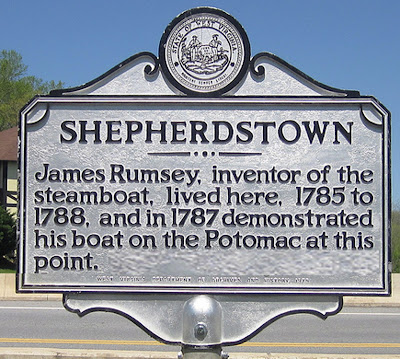

 "Though Ramsey’s steamboat was first, many credit the invention to Robert Fulton, the man who mastered the production of the steamboat. But no matter whom the original inventor, the steamboat opened new worlds of navigation for the people of Shepherdstown, making opportunity and commerce easily accessible," concludes the C&O Canal Trust website. 

And Donald Sharp was able to pinpoint where Rumsey carried out the early major design work for his steam-powered watercraft, near Bayou Lacombe and at the mouth of the Pearl River in St. Tammany Parish. 

As soon as steam-propelled watercraft became available, riverboats became a principal transportation mode for river trading. And although Rumsey was working on backward thrust steam propulsion, the groundwork was laid for stern-wheeler and side wheeler steamboats as well as propeller driven watercraft. When the steamboat was perfected and came into regular use, the city of New Orleans  began

It's good to know that St. Tammany played an early part in the invention of the steam-driven watercraft. Today's version of the backward thrust boat propulsion system? Jet-Skis and Wave Runners.


 A large exhibit detailing the life and accomplishments of inventor James Rumsey is now on display at the  Maritime Museum Louisiana in Madisonville. 

The exhibit includes several panels and scale models representing the development of the steamboat, from its earliest incarnations to its large sternwheeler watercraft that plied the waters of the Mississippi River and made New Orleans what it is today. 

Donald J. Sharp provided the historical research that went into the creation of the James Rumsey exhibit, particularly the information on how Rumsey once lived on Bayou Rouville off Bayou Lacombe, and also on Pearl River Island southeast of Slidell. There is evidence that he worked in secret on his steamboat invention at those two locations, before being forced to re-locate to Baltimore, Maryland, by the American Revolution. 

The maritime museum exhibit celebrates the local contributions to the early steamboat design, an invention that changed the course of history.


A video featuring a detailed interview with Sharp explains the sequence of events that brought Rumsey to St. Tammany Parish, and how his contributions led to boats being able to overcome the current of a river and move upstream carrying people and goods to points all along the Mississippi River. 


One part of the exhibit tells about Don Sharp and his research


See also:

The Complete James Rumsey Story

Tuesday, December 25, 2018

Land Grants To The French Along the North Shore of Lake Pontchartrain

A comprehensive record of early Land Grants given to the French along the north shore of Lake Pontchartrain was provided by Anita R. Campeau and Donald J. Sharp in a lengthy article in the July, 2008, edition of "New Orleans Genesis," the publication of the Genealogical Research Society of New Orleans. 

To read the entire article, CLICK HERE for a PDF file.

Here are some maps that were included in that document. Click on the images to make them larger. 


To read the entire article, CLICK HERE for a PDF file.

Wednesday, November 21, 2018

Land Grants From Bayou Castin To The Tchefuncte

In 2009 Anita R. Campeau and Donald Sharp published an extensive article detailing the British and Spanish Land Grants that had been recorded along the north shore of Lake Pontchartrain from Bayou Castin to the east to the Tchefuncte River to the west.

To read that article, CLICK HERE for a PDF file.

The article listed dozens of family names and the individuals who helped settle St. Tammany Parish beginning in the 1770's.

Here are some illustrations from that article.


The article was published in the April , 2009, edition of the New Orleans Genesis, a publication of the Genealogical Research Society of New Orleans.